3.31.2012

Symphony of the Goddesses Impressions

As a huge Zelda fan, I had high expectations when attending The Legend of Zelda: Symphony of the Goddesses, but knew I would enjoy it regardless. That being said, the concert was incredible. It had everything I would have wanted and more. The whole thing was two hours long... I could have listened all night.

The concert, at Davies Symphony Hall, was last Wednesday, March 28. The event was sold out, but nowhere near a full house. There was an unsurprising young crowd, but I did expect to see more stereotypical concert-goers in attendance. Probably more than a third wore Zelda paraphernalia; only a fourth were in appropriate business or semi-formal attire. Most of the audience wore street clothes. A handful were cosplayers.

Upon entering the lobby, we could hear music wafting through the building, barely discernible over the excited buzz of the crowd. But between tracks, an unmistakeable voice shouted "Hey, listen!", causing everyone in the know to look around and ask their friends if they heard that too. In the music hall itself, a large screen dominated the room. An eloquent Hyrulian Crest was projected onto it, immediately invoking nostalgic emotions and anticipation. I sat front and center (in the nosebleeds). But in an intimate venue like Davies, there are really no bad seats.


I do not have the literary skills to appropriately describe the concert. I'll just say it was awesome.

Okay, I'll try a little more detail. The show opened with a beautiful medley of the most recognized music in the Zelda series as it tried to establish the basic story and history. Starting with the very first scene of the first game, we were shown footage of every console game. All the introductory stuff nicely melded together. And I think that's the only time we heard anything from Skyward Sword. The melding and establishment of continuity was furthered in the next piece, which was Kakariko Village from the three games it was featured in. This was nice, but not very remarkable aside from how the music was mixed into each other.

The really good stuff started with the Ballad of the Wind Fish. I mean, there were times 15 years ago when I would turn on my Gameboy just to listen to music from Link's Awakening. What I'm trying to say is that that song was amazing when it was limited to the "beep beep beep" of the Gameboy's technology. So hearing it fully orchestrated is mind-blowing.

And that's really the whole point of this concert. The music in any form invokes memories from the past 25 years. And when listening to any musician play live, you get to hear and feel that raw emotion in a way that the music takes on its own personality. Combine all that into a full symphonic orchestra, and I was primed to swept up into it all. Not to mention the visual aspect, which at varying times either added to or detracted from the experience. It's another sense to appeal to, but on occasion distracted me.

Then started the "movements" of the concert. I use quotation marks, because they were not really movements as much as epic medleys, each from a major console game. The departure from a traditional formula was probably intentional because of the younger crowd that is ignorant of concert etiquette. So if we're going to applaud after each piece, might as well make each movement one continuous segment, right?

Naturally, Ocarina of Time was the first movement. The story that flashed on screen was out of chronological order, but suited to fit the rise and fall of the movement. Especially remarkable was the Great Deku Tree theme, as the cello really resonated with me. I didn't really feel the dramatic points featuring Ganondorf, maybe because I was too far away to feel the bass. Overall, they pretty much covered everything, and extensively went through this game more than any other.

The Wind Waker. Arguably the series' most musically artistic game. They did not disappoint here. How could you with such a rich selection? The music swept back and forth with whimsy and constantly returned to ocean theme, much in line with the game.


After an intermission was the Great Fairy Fountain, a nice, short, one-dimensional piece, but still incredible to hear the live harp action.

Continuing on our tour of console games, the next stop came to Twilight Princess. This game does not have much standout music, but definitely had some of the most dramatic, and this, I think, was fully taken advantage of. Some parts in the middle really felt like I was not just playing the game, but actually fighting. I don't think they deviated from the track that was in the 25th Anniversary CD bundled with Skyward Sword. At this point, however I got tired of watching the final battle scenes with Ganon. It was the third time we saw the guy die that night. But at least he doesn't appear in Skyward Sword, so it shouldn't get too stale.


At this point I started thinking it was a shame that they're not playing anything from A Link to the Past.


3.24.2012

The Master Tube

I present my latest foray into Zelda-related arts and crafts. Actually, I haven't handmade any Zelda items for years. But I made this for the upcoming Zelda Symphony. It's a glorified poster tube, modeled after the Master Sword scabbard in Twilight Princess. The idea, really, is to protect the concert poster I plan on purchasing as soon as I get into the concert hall lobby, and I might as well do it in style.


2.14.2012

The History of Hyrule

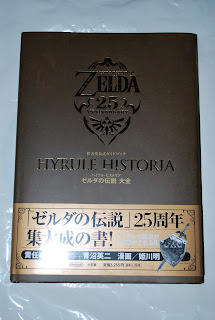
A copy of Hyrule Historia is now in my possession. Quite a nice birthday/valentine present. It's a beautiful book with fantastic artwork. I cannot, however, read a single word of it. Still, this is a must-have for a Zelda fan and will become more and more relevant as other fans translate it online from Japanese to English.


Item: Hyrule Historia
Manufacturer: Shogakukan (小学館)
Release Date:  12.21.2011
MSRP: ¥3100 (~$40)
Dimensions: 10.4 x 7.5 x 0.9 in.
Run Release: Limited
Licensed by Nintendo: Yes
Additional Information: Written entirely in Japanese; 274 pages

1.10.2012

Music to My Ears

It came in the mail today! The Legend of Zelda: Symphony of the Goddesses! Nevermind that I haven't been to a concert hall since grade school or that I have to dress up. It's Zelda, baby. The worry of uncertainty that it wasn't going to tour the Bay Area is gone, replaced by anticipation and waiting 10 weeks.


1.01.2012

Triforce in the New Year

Happy New Year!

Couldn't help but notice last night that the Times Square Ball in New York is comprised of a bunch of Triforces. Not only that, but as the ball dropped, at count 10 it was lit up in gold!


http://timessquareball.net
http://opensupportindia.com/blog/2011/12/on-top-of-the-world-a-visit-to-the-times-square-new-year%E2%80%99s-eve-ball/

What a way to ring in 2012... with power, courage, and wisdom.

12.29.2011

Spock Found the Triforce

I recently started watching the original Star Trek movies. They're pretty awesome, but ultimately not relevant to a Zelda journal. However, while watching "The Search for Spock", I noticed something during the recap of "Wrath of Khan".

Spoiler Alert for Wrath of Khan!
I took a screenshot of the moment when Spock died. Spock is inside the engine room of the Enterprise. Notice the signage on the right side of the screen that includes none other than the Triforce! I can't believe I caught this on the recap and not from the actual movie. Well, I can excuse myself 'cause I was probably focused on Spock dying and not on wall designs.

Now I'm not a Trekkie (I mean I saw the movie 29 years after its release), but this choice of symbolism seems odd in the movie. I don't think there's much symbolism in the Star Trek movies although I could be wrong. Perhaps it was just a techie-looking symbol to put in a room that houses a nuclear reactor. For such a dangerous room there should be more signage. But overall the walls on the Enterprise are barren, so the Triforce looks a bit out of place. And to boot, it's included in a highly emotional scene. What could it mean? Maybe a more appropriate question is: Does it mean anything? Probably not.

There is almost certainly no relation of this to Zelda. "Wrath of Khan" came out in 1982, four years prior to the 1986 release of the original "The Legend of Zelda". The movie even came out a full year before the Famicom system was released in Japan. So the movie came and went long before development of Zelda started.

So this becomes merely an interesting tidbit. Here's another Triforce spotting from the end of "The Search for Spock":


Awesome garb... they're for a Vulcan ceremony. There's a plain triangle on the back too. This should be what the sages wear in Zelda. Or just recreate this screen in a Zelda game. The Vulcans with their pointy ears can pass for Hylians.

12.26.2011

The End of Skyward Sword

Oh, that feeling once you beat a great game. A sense of wholeness and satisfaction slowly overcome by sadness that it's over and a thirst for more. Because we can never truly be satisfied, right? I finished Skyward Sword last night. Well, not completed as in 100%ed, but I beat the final bosses. All in 64 hours of play within 35 days. I had hoped it would take longer, and I did try to spread it out and take my time. Overall I am very happy with the game and it leaves me oh so hopeful about how the next Zelda game will improve upon its core gameplay. I'm over these motion controls though.

Well I guess there's nothing left to do but play it to completion. I'm missing 3 whole hearts and at least one story of gratitude crystals. I don't think I'll play there Hero's Quest yet. I'll save that for my hardcore 100% runthrough.